

A Strategic Guide to the FDA's New Quality Management System Regulation (QMSR)
Beyond the Deadline...
On February 2, 2024, the U.S. Food and Drug Administration (FDA) published its final rule to amend 21 CFR Part 820, officially replacing the long-standing Quality System Regulation (QSR). The new rule, titled the Quality Management System Regulation (QMSR), becomes fully effective and enforceable on February 2, 2026.
While this two-year transition period may seem adequate, industry analysis suggests a full QMS transition is an 18- to 24-month project. This timeline means that organizations that have not yet begun strategic planning are already at risk of falling behind.
This article provides an overview of the three most significant strategic changes medical device manufacturers and their suppliers need to understand.

1. The "ISO 13485-Plus" Framework: Compliance Beyond Certification
The core of the new QMSR is the "incorporation by reference" (IBR) of the globally recognized international standard, ISO 13485:2016. This action is intended to harmonize U.S. regulations with the framework used by most other major regulatory authorities.
However, a critical point of failure will be the assumption that an existing ISO 13485:2016 certification equals full QMSR compliance. The FDA has explicitly stated that an ISO 13485 certificate from a third-party registrar will not exempt a manufacturer from FDA inspection.
The QMSR is an "ISO 13485-plus" framework, establishing additional, specific requirements to ensure consistency with the Federal Food, Drug, and Cosmetic (FD&C) Act.

Key "FDA-Plus" additions include:
- § 820.10 (Requirements for a QMS)
This new "linchpin" section serves as a legal bridge. It explicitly requires the QMS to ensure compliance with all other applicable FDA requirements, including 21 CFR Part 803 (Medical Device Reporting), Part 806 (Corrections and Removals), Part 821 (Medical Device Tracking), and Part 830 (Unique Device Identification). - § 820.35 (Control of Records)
This section adds specific requirements on top of what is required by ISO 13485. It mandates specific records related to complaint handling (linking to Part 803), servicing activities, UDI documentation, and records deemed confidential. - § 820.45 (Device Labeling and Packaging Control)
The FDA determined that the general requirements in ISO 13485 were not specific enough to prevent common labeling failures. Therefore, the QMSR retains the highly prescriptive QSR rules requiring documented procedures to examine all labeling for accuracy and to design operations that prevent mix-ups.

2. A New Lexicon: The End of DHF, DMR, and DHR
The QMSR final rule officially eliminates the U.S.-specific documentation terminology that has defined device manufacturing for decades. This change requires manufacturers to "translate" their documentation systems to the new ISO lexicon.
- Design History File (DHF)
(from old § 820.30) is replaced by the Design and Development File (DDF) (ISO 13485, Clause 7.3.10). - Device Master Record (DMR)
(from old § 820.181) is replaced by the Medical Device File (MDF) (ISO 13485, Clause 4.2.3). - Device History Record (DHR)
(from old § 820.184) is functionally replaced by ISO's requirements for Production and Batch Records (e.g., Clauses 7.5.1, 7.5.8).
This transition should be viewed as an opportunity to re-architect document control systems. The new ISO structure (DDF-informs-MDF) is well-suited to modern eQMS and PLM systems, enabling a "single source of truth" that can reduce redundancy and the risk of using obsolete documents.
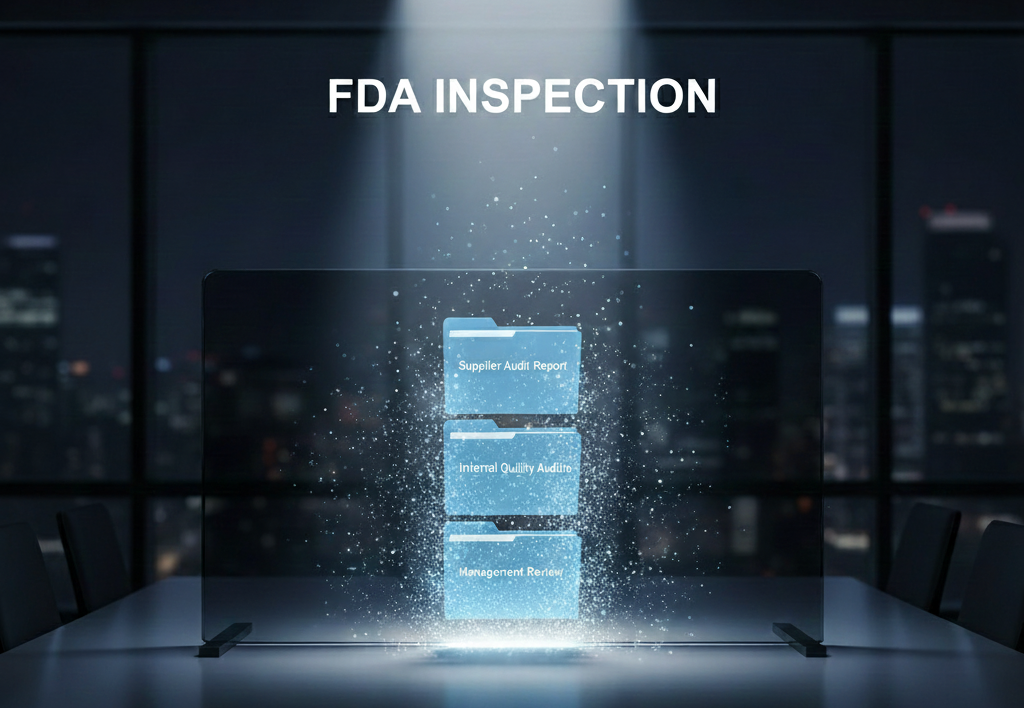
3. A New Era of Transparency: The Elimination of Record Exemptions
Perhaps the most operationally disruptive change in the QMSR is the
elimination of the record exemptions previously codified in QSR § 820.180(c).
Under the old QSR, FDA investigators were explicitly prohibited from reviewing the reports and findings from:
- Management Reviews
- Internal Quality Audits
- Supplier Audits
Under the new QMSR, these exemptions are eliminated. The FDA now has the full authority to request and review all of these records during a routine inspection.
This change fundamentally alters the regulatory landscape. It creates a "smoking gun" scenario where, for example, an FDA inspector at a manufacturer's facility can request and read the complete supplier audit report for a critical contractor, including all detailed findings of non-compliance. This creates a new and significant regulatory liability for both the manufacturer and the supplier.

Recommended Strategic Actions
Given the 18 to 24 month timeline for a full QMS transition, waiting is not a viable strategy. Organizations should begin immediate planning.
- Conduct a 3-Way Gap Analysis:
The analysis must compare your current QSR against not only ISO 13485:2016 but also the specific "FDA-Plus" requirements in § 820.10, § 820.35, and § 820.45. - Revise Internal Oversight Procedures:
Procedures for internal audits, management reviews, and supplier audits must be revised. Personnel should be trained on how to write reports that are candid, objective, and actionable—while remaining factual and concise—now that they are subject to FDA inspection. - Review and Renegotiate Quality Agreements:
In this new, transparent environment, Quality Agreements (QAs) are a critical legal tool. This is especially true for critical suppliers, such as sterilization contractors, who now face indirect liability from their clients' audits. It is advisable to review QAs to contractually manage this new, transparent audit process.

Navigating Your QMSR Transition
The transition to QMSR is a significant undertaking, requiring deep expertise in both ISO 13485 and the FDA's specific regulatory requirements. This is especially true when integrating risk management throughout the QMS, rewriting procedures, and preparing for the new era of inspectional transparency.
Quantum EBX specializes in building and supporting robust Quality Management Systems for medical device manufacturers and sterilization facilities. Our services are designed to address these exact challenges, including:
- QMS Gap Analysis & Implementation
We can conduct a comprehensive 3-way gap analysis (QSR vs. ISO 13485 vs. "FDA-Plus") and help you design, document, and implement a fully compliant QMSR. - Procedure Development
Our team can assist in rewriting and developing the new SOPs, work instructions, and documentation required by the new lexicon (DDF, MDF) and risk-based approach. - Audit & Compliance Support
We can help you establish and manage internal audit programs and provide support for readiness reviews, ensuring your team is prepared for the new inspectional process. - Sterilization & Supplier QMS
For contract sterilizers and critical suppliers, we provide specialized services to ensure your own QMS is compliant and to help you prepare for the increased scrutiny from your clients' new supplier audit requirements.
This change is an opportunity to modernize your quality system for global compliance. If you are beginning your transition planning or require expert support to ensure a seamless implementation,
contact us
to learn how we can help.